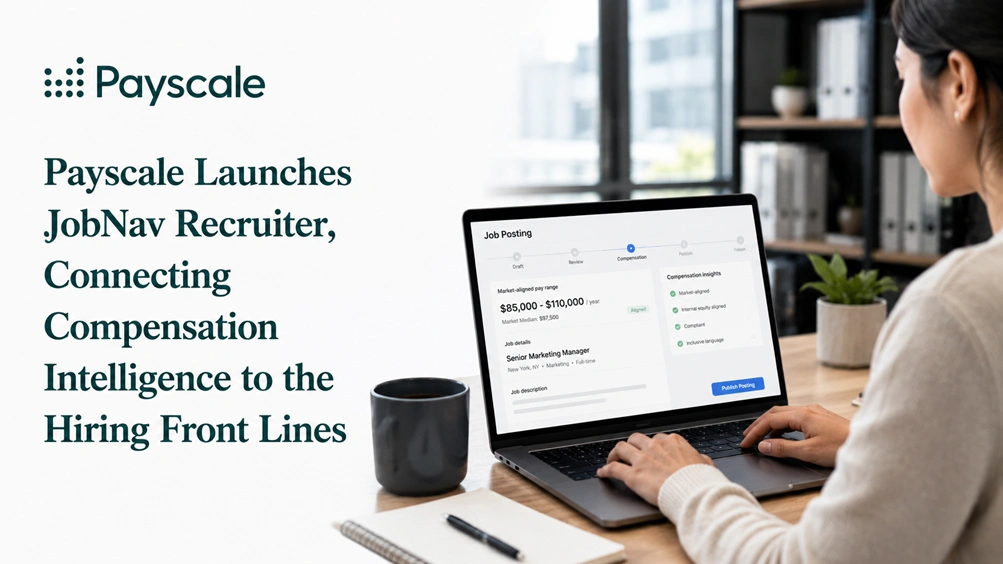
Payscale has launched JobNav Recruiter to strengthen compensation intelligence in hiring workflows. The compensation intelligence solution connects recruiter activities with enterprise pay strategies. Moreover, it helps organizations improve compliance and maintain pay consistency.
This tool plugs directly into the workflow of recruiters and the ATS. Consequently, recruiters are able to craft legal job descriptions with ease. In addition, recruiters can post salary ranges that align with the labor market.
JobNav Recruiter adds more capabilities to the Payscale Intelligence Cloud. Also, JobNav uses technology obtained through Payscale’s acquisition of Datapeople in 2025. Thus, it bridges the gap between internal pay strategy and external job advertisements. But many companies face the issue of hiring systems that are not integrated. Usually, recruiters manually rewrite job advertisements and salary ranges.
“In theory, comp and talent acquisition should work closely. But in practice, there is a gap between what comp designs and what actually gets posted. That’s where an organization’s compensation strategy starts to unravel,” Payscale Chief of Business Operations and HR Officer Lexi Clarke said. “JobNav Recruiter is compensation intelligence working where the hiring decision actually gets made in the posting and offer, at the front lines of hiring. When recruiters aren’t flying blind, organizations stop losing control of the compensation strategy they built.”
Bridging Compensation Strategy and Recruitment Workflows
The compensation intelligence system takes care of the differences in the areas of compensation and talent acquisition. It makes sure that there is harmony between job listings and the pay structures already approved. Besides, it offers more clarity regarding the way the candidate sees the listing. It also helps recruiters go from the draft stage to the job listing within 30 minutes.
Furthermore, JobNav Recruiter includes the feature of AI-enabled scoring for early identification of compliance risks. Also, governed job architecture is used for mapping postings to job structures. Lastly, benchmarking data helps in setting appropriate and defensible salary ranges.
The real-time analytics also contribute to making the hiring process more efficient by monitoring posting effectiveness. All these efforts go a long way in helping improve candidate quality and increase cost-effectiveness. The future plan for the company is to introduce new HRIS integration and language capabilities. In the end, the goal is to make the compensation process ongoing.
Explore HR Tech News for the latest advancements in Human Resources Technologies and insightful updates from industry experts!
News Source: GlobeNewswire.com